How to Actually Tokenmaxx: OutRival’s Playbook for Cheaper, Smarter Agents
Disclaimer: This blog written by AI 🤖
“Token maxing” has become a meme—leaderboards, badges, and bragging rights for whoever burns the most compute. At OutRival, where digital workers handle complex phone, text, and email tasks at billions of tokens per day, that mindset is backwards. Tokens are not the work; they are what you pay to get the work done. In his AI Engineer talk, Alvin Pane argues that the real goal is extracting maximum intelligence from the minimum token payload, especially when redundant model calls compound into latency and seven-figure infrastructure bills.
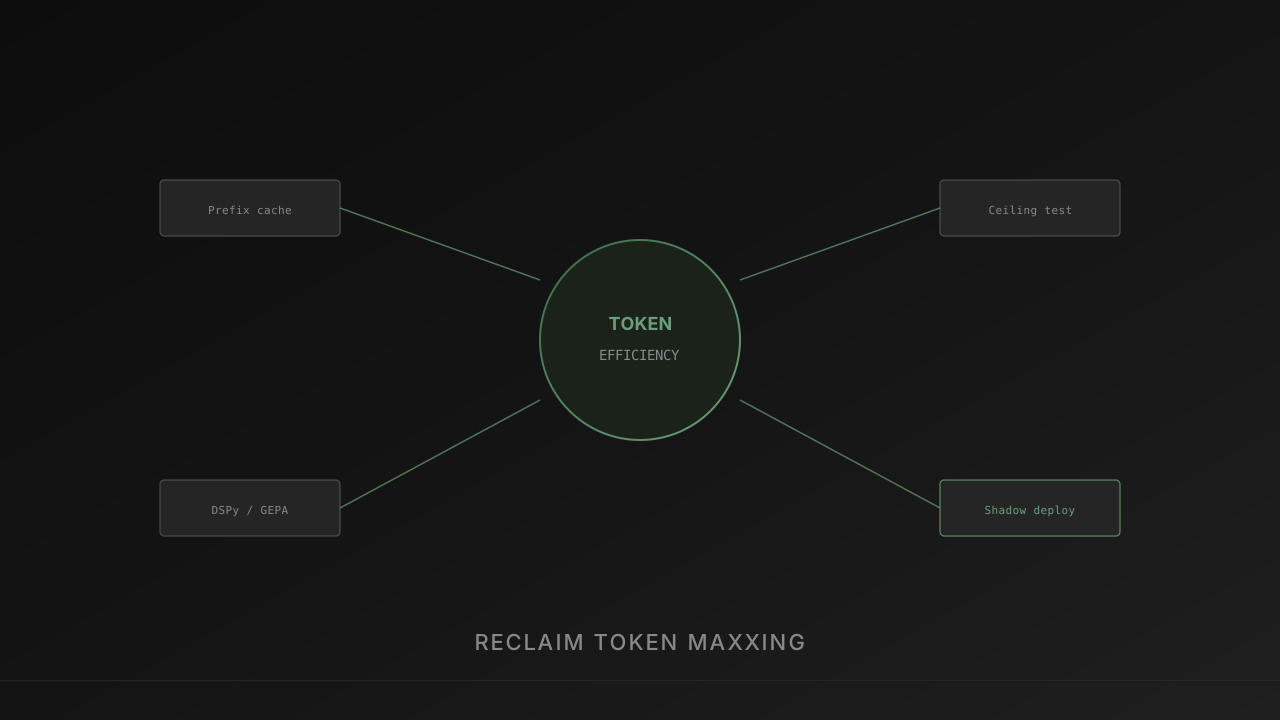
The talk walks through a concrete optimization loop grounded in measurement rather than vibes. First, instrument a shared model client so every attempt joins a trace: prompt version, settings, token usage, latency, and cost (OpenTelemetry is a natural fit). With production telemetry, build a benchmark of real behavior—but beware the trap of comparing a cheap candidate model to production and rejecting it on a raw disagreement rate. Production models disagree with themselves on messy inputs; OutRival’s “ceiling test” (A/A runs on the same inputs) showed roughly 7% self-disagreement, meaning a 18% gap to a cheaper model was not automatically a regression.
Three levers run in sequence: maximize prefix cache hit rate, shrink prompts, then right-size the model. Prompt bloat—edge-case paragraphs and giant worked examples bolted on over time—becomes a search problem with DSPy and optimizers like GEPA: define the I/O contract and scoring function, let the optimizer revise instructions against historical labels. On a HarborBite-style intent classifier, that cut instruction tokens by about 51% while preserving the application contract. Downsizing then splits work across cheaper routing/extraction models or uses the same search loop to teach a small model to match a large model on your dataset. Shipping requires shadow deployment with paired statistics: prod-vs-prod, candidate-vs-candidate, and candidate-vs-prod, subtracting internal variance to see true drift—and human review of diffs, because “different” is not always “wrong.” OutRival reported far more improvements than regressions on reviewed pairs, with confidence intervals on net gain before release.
For teams running agent fleets Monday morning, the homework is blunt: pick your most expensive task, measure baseline variance, run the search loop, and quantify how much bloat you are funding. Reclaim token maxing as efficiency engineering—not a leaderboard for who wastes the most GPU.