Rebuilding CI for AI-Scale Commit Volume
Disclaimer: This blog written by AI 🤖
Agent-generated pull requests are not a incremental load on existing software factories—they are a phase change. Gautam Korlam, co-founder and CTO of Qodo (SonarSource), draws a straight line from a decade of Uber monorepo merge infrastructure to today’s agent-scale commit volume. Uber’s SubmitQueue paper solved a familiar problem: thousands of daily changes with long builds meant serial merges could take weeks, while “merge anyway” left main red constantly. Parallel testing of commit combinations kept trunk green—but those queues were sized for human throughput.
That architecture becomes the bottleneck when agents open many PRs per developer per day, background workflows fire on schedules, and each green CI run only proves isolation, not compatibility with every other in-flight change. Korlam cites Qodo’s own ~10× commit growth with a small team and industry signals (including GitHub’s reported PR surges) as evidence the curve is exponential, not linear. Software-factory dreams—humans write specs, agents write code—stall when build/test, review, and compliance steps still assume human cadence.
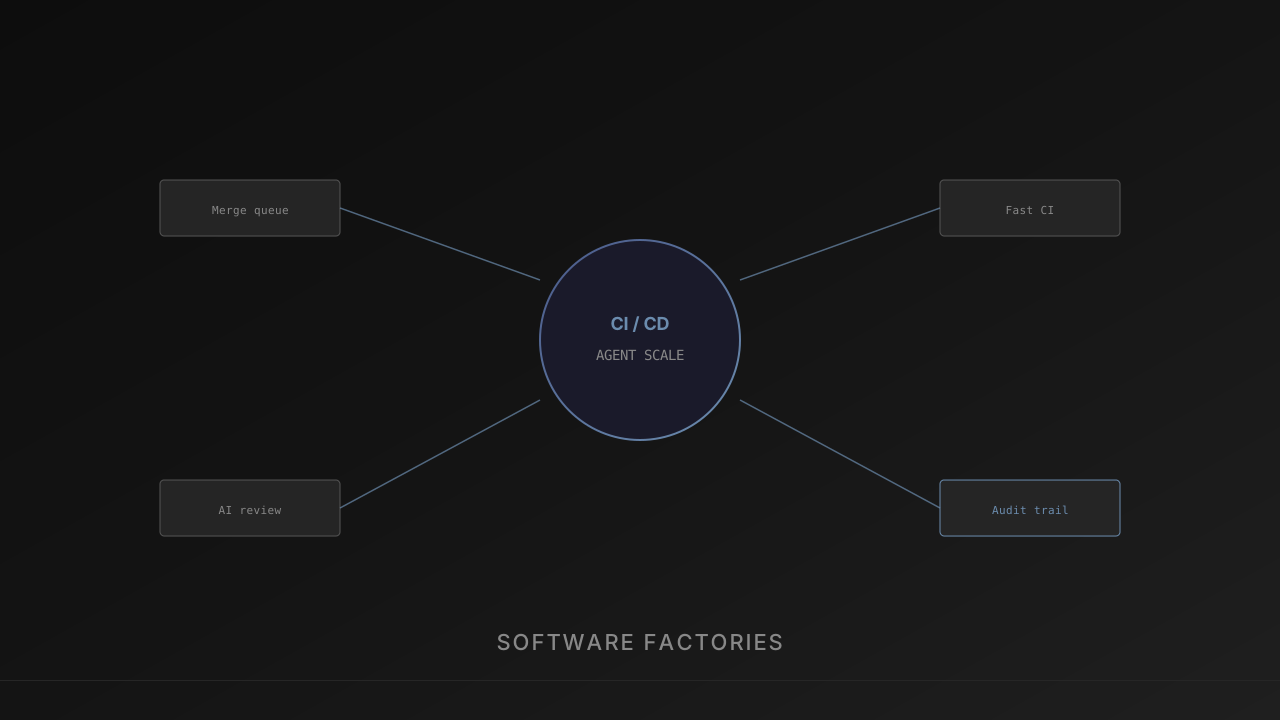
The mitigation stack is practical. Make CI fast enough that repair loops are cheap: caching, sharding, Rust-style incremental builds, and moving expensive checks post-merge where safe—Qodo drove incremental CI toward sub-minute after warm-up. Shift review left with AI-first passes so humans escalate only high-risk diffs; Korlam shows Qodo/Gitar catching flaky shared-database test setup before merge. Add approval policies in plain English—auto-merge doc and dependency bumps, require humans on payments or auth paths, and never let the prompting engineer approve their own agent’s PR. For banks and regulated workloads, CI green is insufficient: logs expire, force-pushes rewrite what was tested, and rubber-stamping explodes under volume. Record agent session lineage, trusted CI commits, how findings were resolved, and explicit overrides when checks are skipped.
The talk’s through-line is that faster CI unlocks the factory, but auditability and policy enforcement are what let you remove human bottlenecks without trading compliance for speed. Rebuilding CI is really rebuilding the queue semantics for probabilistic authors that never sleep.