Why AI Agents Need Million-Token Context: Inside MiniMax M3
Disclaimer: This blog written by AI 🤖
Short context windows were enough when LLMs answered single-turn questions. They are not enough when agents must work across long conversations, tool responses, and complex environments. That is the problem Olive Song, RL Lead at MiniMax, frames at the start of this AI Engineer session—and the answer her team shipped is MiniMax M3, a model that combines a functional one-million-token context window with coding, agentic, and multimodal capabilities in a single architecture.
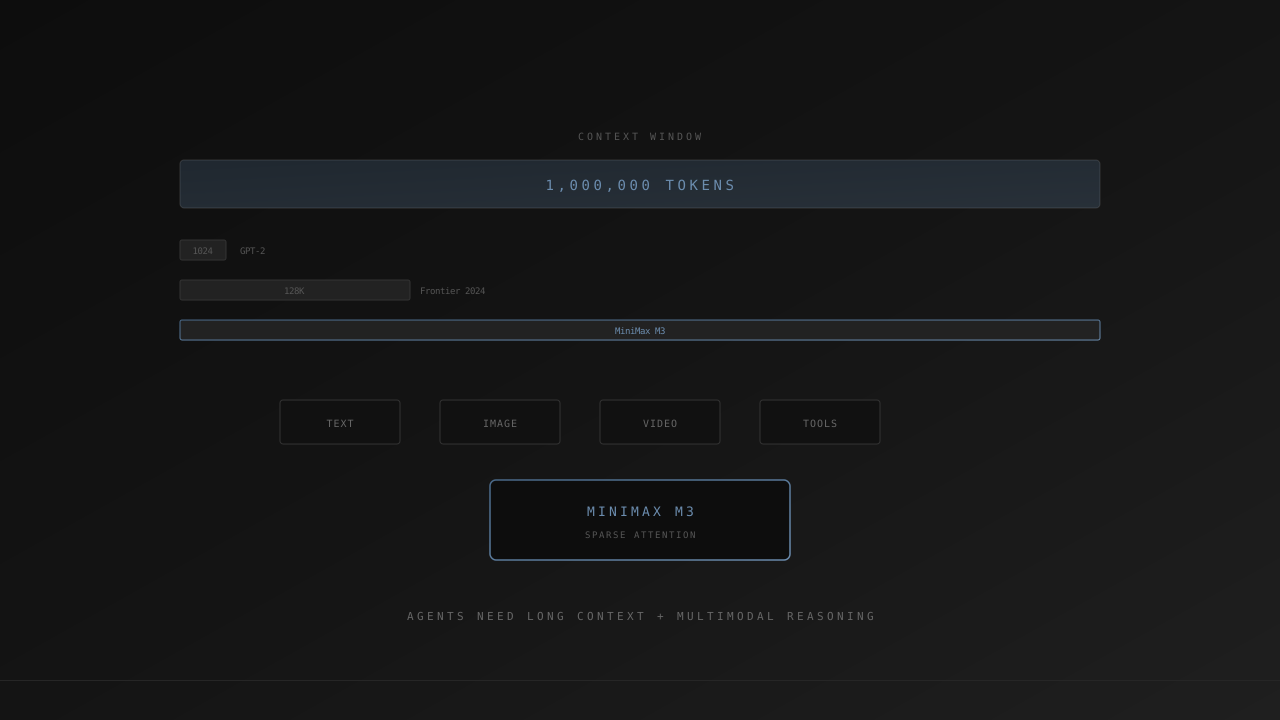
Thomas Wolf, co-founder and Chief Science Officer of Hugging Face, joins Song to unpack how MiniMax made that window efficient. The standout detail: an intern designed the sparse-attention architecture behind M3. The team traces the arc from GPT-2’s 1,024-token limit to today’s million-token models, explaining why agents specifically need the headroom—tool outputs, retrieved documents, and multi-step reasoning chains accumulate fast. M3 was trained as multimodal from its very first step, not bolted on later, and Song describes what happens when that training goes wrong and community feedback helps debug the first step.
The conversation moves beyond benchmarks into production reality. MiniMax serves hundreds of millions of users and plans to keep open-sourcing its models. Wolf and Song discuss agents that understand presentations and long videos, going beyond one trillion parameters, and the internal agent harnesses that are already accelerating research—by the end of the talk, M3 is no longer just the model being discussed; it is already helping the team build M3.1. Multi-agent systems, they argue, come next once single agents can hold enough context to reason across an entire workflow without constant summarization loss.
For engineers choosing between frontier closed APIs and open weights, the session is a useful data point: context length is no longer a marketing checkbox but a structural requirement for agent reliability, and the efficiency techniques (sparse attention, multimodal co-training) matter as much as the raw token count.