500 Skills, Zero Fine-Tuning: LinkedIn's Playbook for Enterprise AI Agents
Disclaimer: This blog written by AI 🤖
Coding agents like Claude Code, Cursor, and GitHub Copilot are trained on public code — they have no knowledge of your internal infrastructure, proprietary databases, custom experimentation platforms, or the tribal knowledge that new engineers spend a week learning in boot camp. Ajay Prakash, Senior Staff Software Engineer at LinkedIn, opens his AI Engineer talk with that ceiling and then shows how LinkedIn broke through it without fine-tuning a single model. The result is CAPT (Contextual Agent Playbooks and Tools), a unified MCP-based framework now powering AI-assisted development for more than 1,000 LinkedIn engineers.
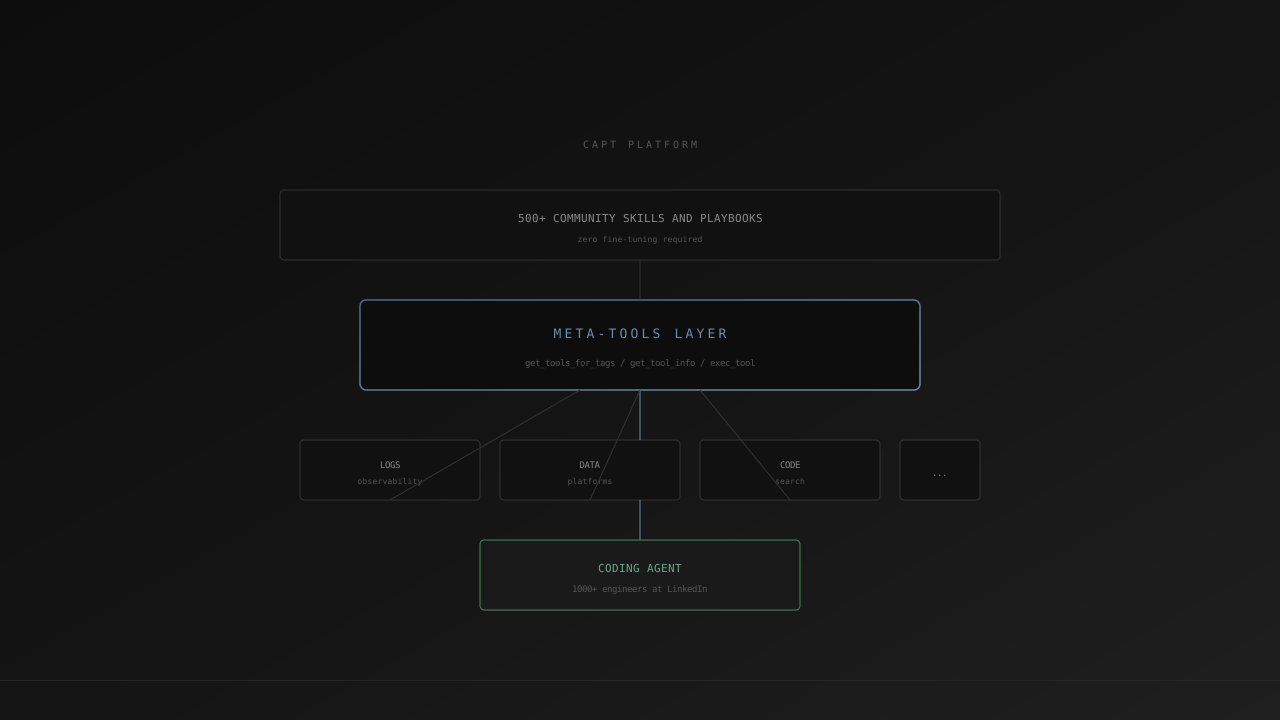
LinkedIn found that even agents with broad MCP tool connectivity still hallucinated, got stuck, or produced untrustworthy code because critical procedural knowledge was scattered across wikis, Slack threads, and outdated docs. Three compounding failures drove this: agents lacked step-by-step guidance for complex workflows, tool outputs progressively consumed context windows causing information loss mid-task, and agents had no durable memory between sessions. CAPT addresses all three by flipping the tool exposure model — instead of registering hundreds of tools directly with the LLM, the CAPT MCP server exposes a small set of meta-tools (get_tools_for_tags, get_tool_info, exec_tool) that sit in front of thousands of underlying capabilities tagged by function.
The skills layer is where institutional knowledge becomes executable. Playbooks are structured, step-by-step workflows delivered as MCP tool outputs that agents invoke on demand — just like any other tool. The community has authored more than 500 skills covering incident response, data analysis, code review, and experiment cleanup, all without model fine-tuning. A flagship on-call use case demonstrates the impact: an agent fetches runbooks, queries logs and metrics, identifies root causes, creates a fix PR, and updates the incident management system in minutes rather than hours. LinkedIn reports 70% faster issue triage, 3x faster data-to-insight cycles, and adoption scaling through a zero-friction capt setup command that handles OAuth lazily on first tool use.
For teams trying to make coding agents reliable at enterprise scale, Prakash’s playbook is clear: bet on MCP for interoperability, use meta-tools to manage tool discovery at scale, and encode tribal knowledge as playbooks rather than hoping models infer it from raw documentation dumps.