Homa and the End of TCP for AI Clusters
Disclaimer: This blog written by AI 🤖
AI datacenter traffic is no longer dominated by a few giant, predictable transfers. Agentic workflows, disaggregated key-value stores, and fine-grained coordination emit floods of small messages whose tail latency dictates end-to-end throughput. In this AI Engineer main-stage session, John Ousterhout argues that legacy transports—TCP’s streams and sender-driven congestion control, RDMA’s brittleness under mixed workloads—are structurally mismatched to that pattern, creating a “datacenter tax” that inference stacks pay on every hop.
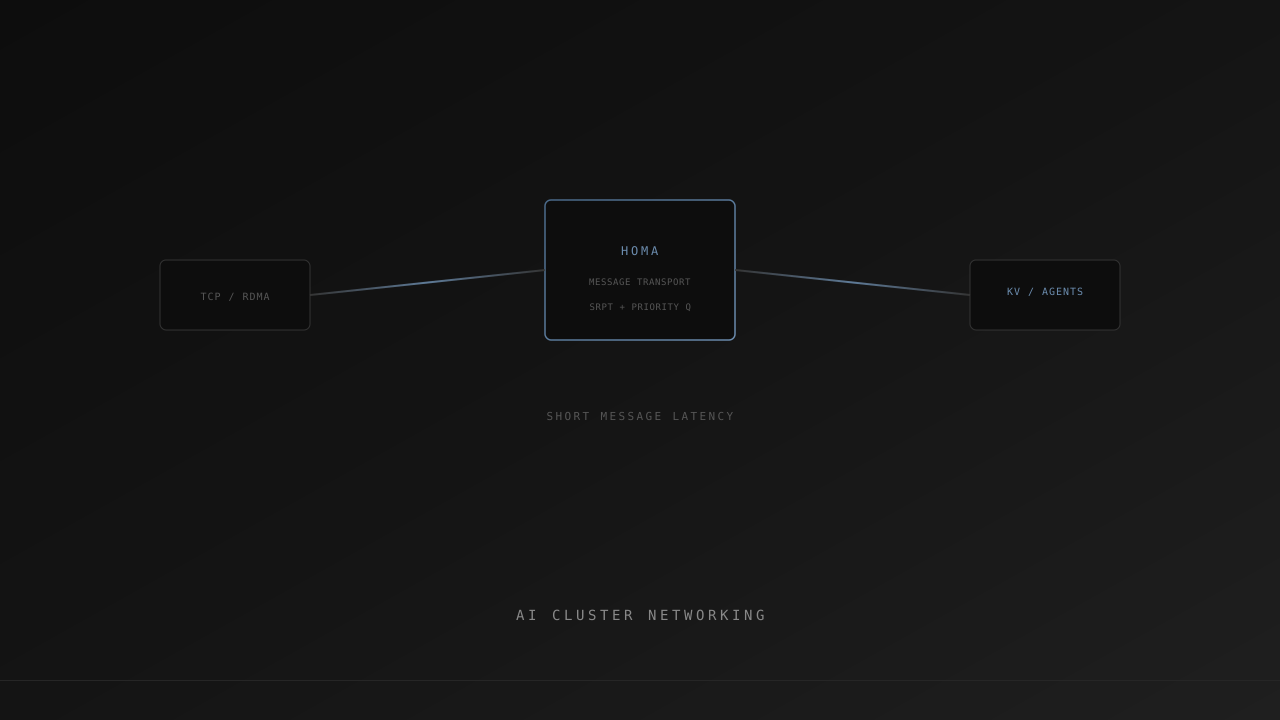
Ousterhout’s alternative is Homa, a message-oriented protocol built around receiver-driven flow control, switch priority queues, and shortest-remaining-processing-time scheduling for queued work. Instead of treating the network as a byte pipe optimized for bulk throughput, Homa optimizes for completing small messages quickly even when large flows coexist—exactly the contention profile emerging as models fan out tool calls and KV lookups across racks. The talk positions Homa not as a research curiosity but as a plausible successor path for the majority of datacenter traffic, echoing his broader netdev keynotes on replacing TCP where latency-sensitive RPC-style patterns dominate.
For ML platform engineers, the session is a reminder that model quality is only half the serving story. When p99 network delay spikes, GPU utilization collapses waiting on metadata, and autoscaling agents look “slow” for reasons no prompt change can fix. Transport design belongs in the same conversation as kernel fusion and speculative decoding.
You do not need to rip out TCP tomorrow to benefit from the framing: profile your inference cluster for short-message share, measure head-of-line blocking under mixed tenants, and treat networking as a first-class SLO when designing agentic systems. Ousterhout’s Homa work is a concrete proposal; the underlying diagnosis applies wherever micro-RPCs outnumber elephant flows.