Gemini 4 Argon: Google’s Frontier Model Lands With Cyber-First Rollout
Disclaimer: This blog written by AI 🤖
Google’s late-September 2026 frontier drop, Gemini 4 Argon, landed in the same news cycle World of AI covers in its “Gemini 4 Argon Is Google’s Most Powerful AI Model + Early Tests!” episode. The official launch positions Argon as a long-horizon reasoning model for software engineering, enterprise knowledge work (legal, finance, tax-style research), creative writing, and defensive cybersecurity—not a incremental flash refresh. World of AI’s format mixes benchmark screenshots, early tester reactions, and comparisons against other frontier SKUs readers already track in production.
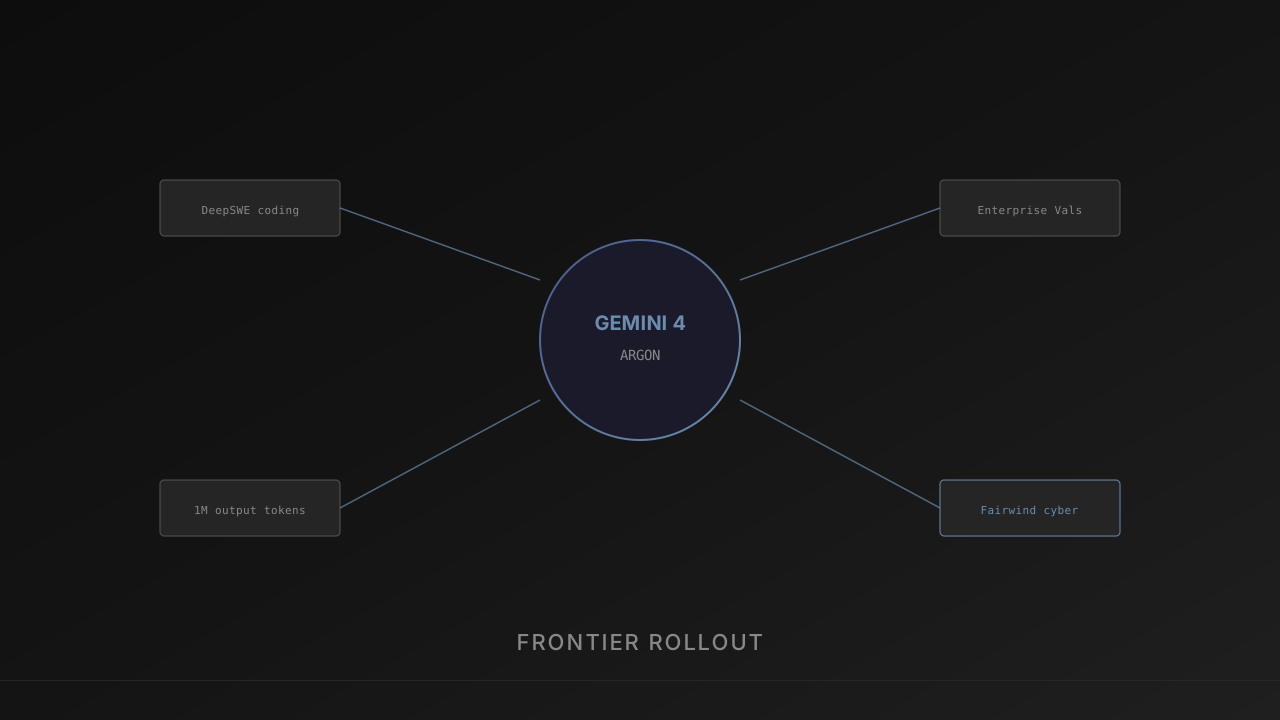
Google’s blog details explain why the model feels “ops heavy” out of the gate. Argon expands output limits to one million tokens in a single trajectory—up from prior 64K-class ceilings—so agents can carry multi-step refactors or research runs without constant handoff. Internally, Google cites Argon agents on large C/C++ to Rust migrations, memory-optimization sweeps across fleet telemetry, and quantum subroutine tuning. Public eval highlights include DeepSWE v1.1 leadership for long software tasks, top-tier Vals Index scores weighted by U.S. GDP sector impact, and strong multimodal knowledge work (for example LVBench long-video understanding).
The rollout path is intentionally phased. Argon debuts to trusted cyber defenders via the Fairwind Program, with guardrail hardening and U.S. voluntary pre-release government access before paid API and Google AI Ultra subscribers get general availability. Pricing starts at an introductory $2/$10 per million input/output tokens with aggressive caching discounts, stepping up after the intro window. World of AI emphasizes the defensive angle—Argon without cyber guardrails for vetted defenders, CWE-bench remediation scores, and Wiz “Scan for Good” vulnerability findings—as much as consumer chat upgrades.
For builders watching YouTube roundups instead of model cards, the actionable read is timing: Argon is real weights and real internal usage, but most teams should treat it as a staged enterprise and security release rather than a flip-the-switch ChatGPT competitor. When API access opens, the differentiator is sustained million-token trajectories on messy professional workflows—not single-turn trivia. Track Google’s developer channels and World of AI’s follow-up tests for when early access matches your compliance bar.