Ending AI Slop: How Taste Labs Turns Subjective Quality Into Trainable Signal
Disclaimer: This blog written by AI 🤖
AI has become extraordinarily good at domains where you can verify an answer, execute a test, or score an output against a rubric. It is still badly behind on the subjective work—the writing, layout, and brand feel where quality is real but hard to pin down. Thais Castello Branco, founder of Taste Labs, starts from that gap and argues that ending AI slop means building data and reinforcement environments for taste, not just scaling generation.
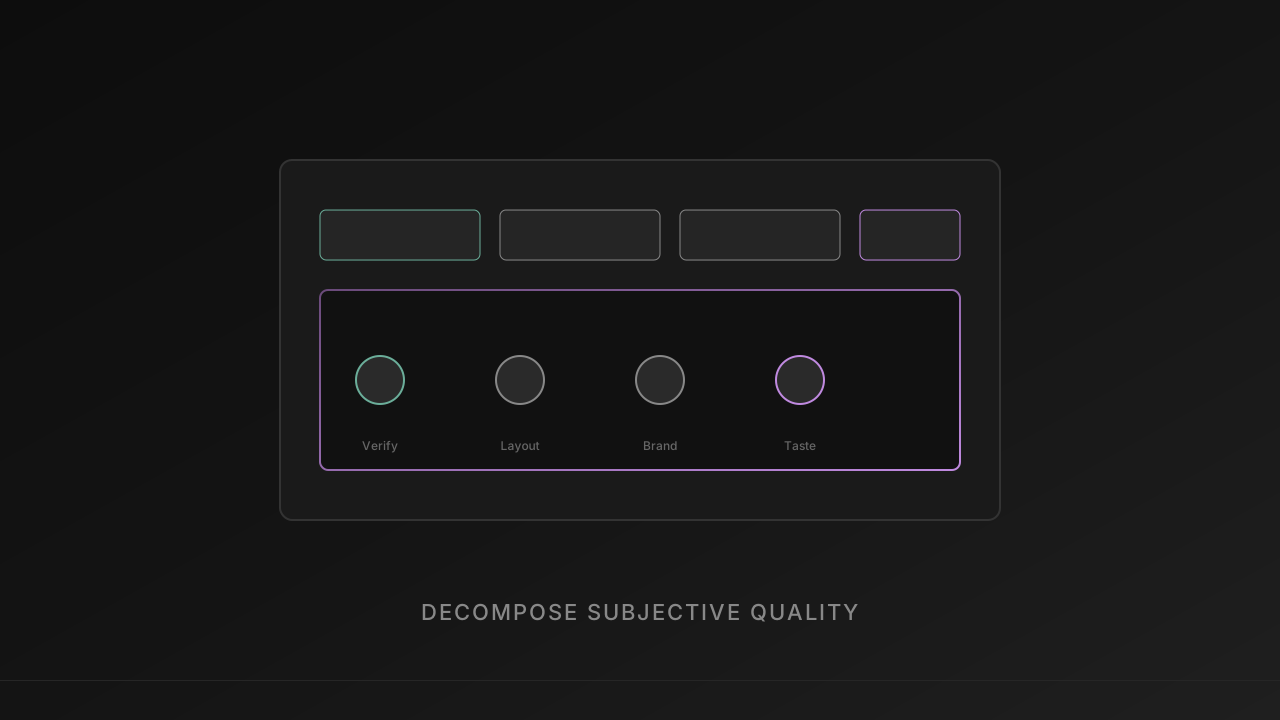
Her talk at the AI Engineer’s World Fair sorts domains along a spectrum. At one end sit tasks that verify and execute cleanly; at the other sits pure preference with no ground truth; most valuable creative work lives in between. The move that makes taste tractable is decomposition: breaking something like a brand guideline or a landing page into elements that can each be graded against an original rather than judged as an opaque whole. Contrast, typography, and instruction-following sit lower on the ladder; style, creativity, and personalization sit higher, where experts legitimately disagree.
The deeper problem she names is collapse to the mean. A model optimizing for the most likely output drifts toward the average and quietly kills the creativity that good design depends on. Taste Labs addresses this by turning expert judgment into structured, high-signal preference data, pairing it with human QA where reviewers tie commentary to specific choices, and keeping the preference vector rich instead of noisy. Her bet is that as more subjective domains become measurable this way, taste stops being a vague complaint about model output and becomes something you can actually train—so AI can produce work that is not only correct, but feels right.