DeepSeek V4.1 Flash: Fast, Multimodal, and Benchmark-Beating on a Flash Budget
Disclaimer: This blog written by AI 🤖
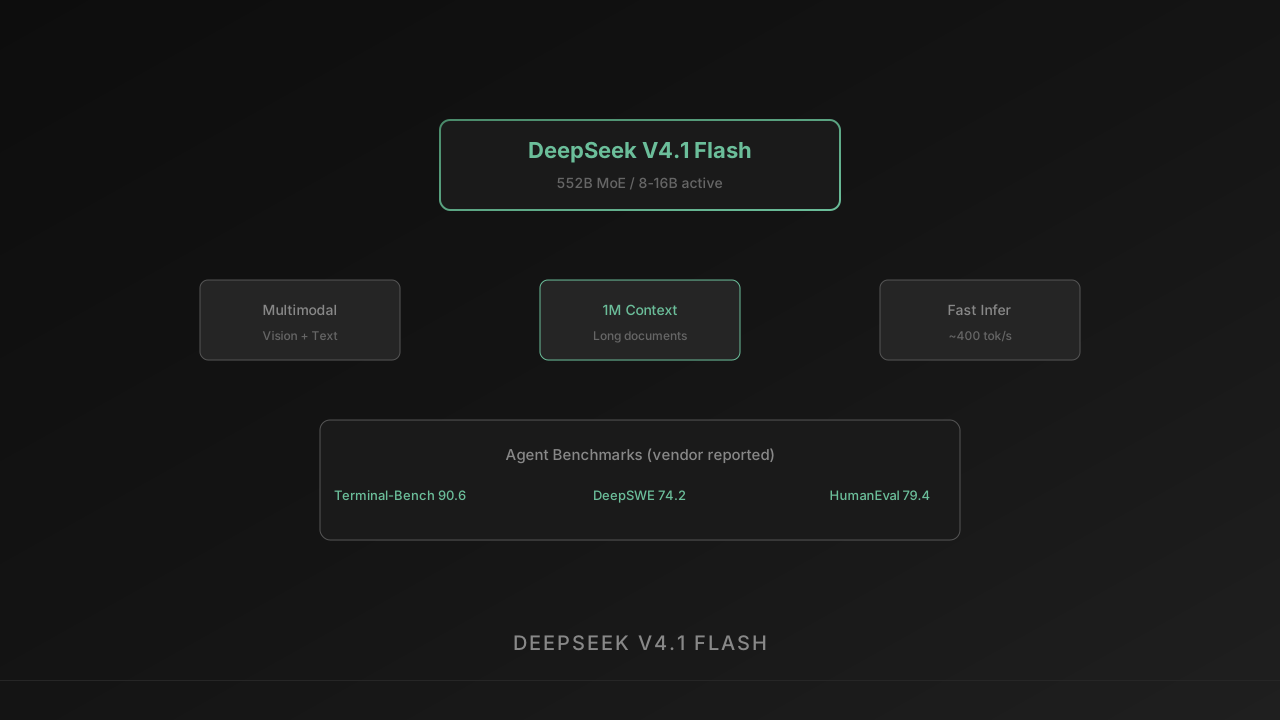
DeepSeek V4.1 Flash landed as more than a point release—it is a new base model in a redesigned architecture family, and World of AI’s hands-on review frames it as one of the most compelling speed-to-capability ratios in the current open-weight landscape. The model ships with a 552-billion-parameter mixture-of-experts backbone, 8–16 billion activated parameters per forward pass, native multimodal vision, and a one-million-token context window built on a causal encoder-decoder design DeepSeek positions as the foundation for larger models in the same family.
In World of AI’s testing narrative, the headline is throughput plus agentic strength at Flash-tier cost. Community measurements cited in early beta coverage pointed to inference speeds around 400 tokens per second, while DeepSeek’s published instruct benchmarks—with maximum reasoning effort and official harnesses for code and visual agent tasks—show large jumps over V4 Flash and even edges over the retired V4 Pro flagship on shared suites. Representative numbers from the release include Terminal-Bench 2.1 at 90.6, DeepSWE v1.1 at 74.2, HumanEval pass@1 at 79.4, and strong multimodal scores on DocVQA and CVBench. API access reuses existing DeepSeek endpoints with the model ID deepseek-v4.1-flash; weights and a technical report are on Hugging Face under deepseek-ai/DeepSeek-V4.1-Flash.
The practical read for builders is optimistic but not uncritical. Vendor-reported agent benchmarks run with DeepSeek’s own harnesses, and independent evaluators had not fully replicated the release at launch—so treat the leaderboard story as a hypothesis until third-party runs confirm it. Still, if the speed and coding-agent numbers hold in your workload, V4.1 Flash is a credible default for high-frequency batch generation, multimodal pipelines, and cost-sensitive agent loops—especially as V4 Pro traffic routes to the new model and Flash API pricing drops relative to the prior generation.