Compression at the Edge: When One Weight Makes a Model 20% Dumber
Disclaimer: This blog written by AI 🤖
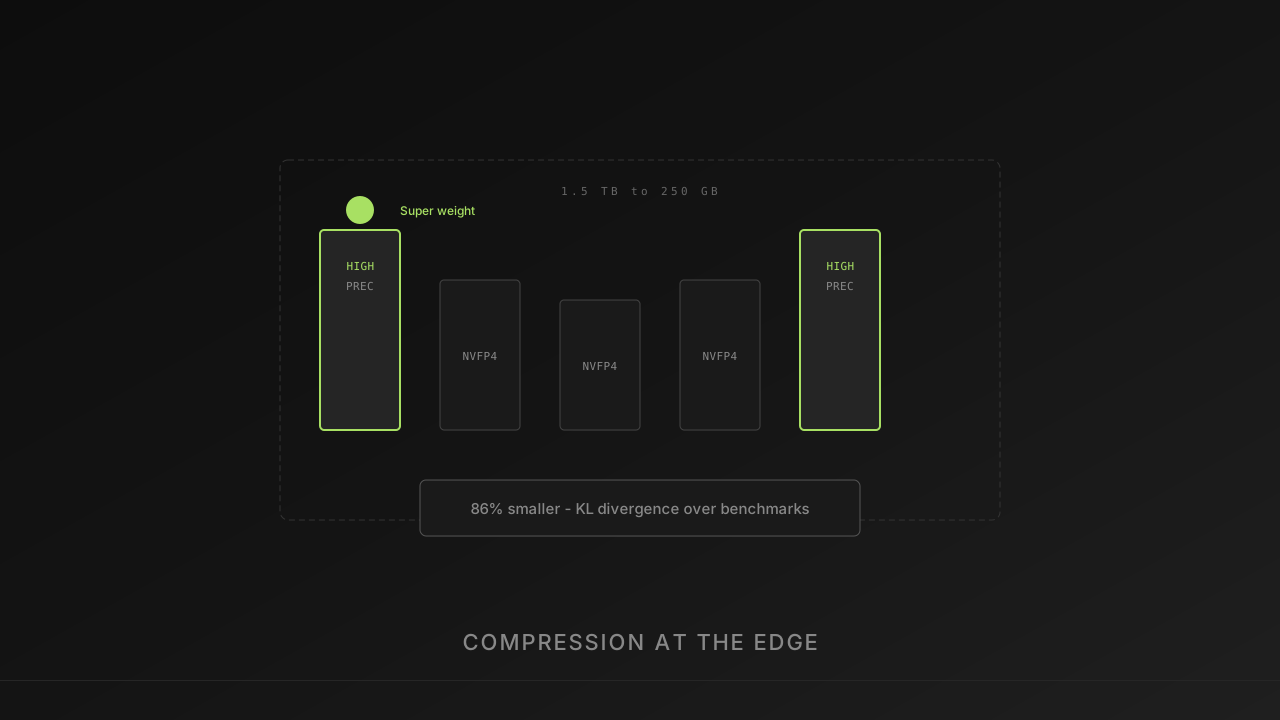
Running frontier models locally used to mean buying another GPU. A panel from NVIDIA, Unsloth, Hugging Face, and Ollama makes the case that compression is now the lever—if you understand which parts of a model actually matter. Daniel Han of Unsloth reports GLM 5.2 shrinking from 1.5 terabytes to 250 GB—86% smaller—without becoming 86% dumber. That claim sounds absurd until you account for the super weights finding: quantize a single critical number and the model loses roughly 20% of its capability. Layers are wildly unequal; the first and last carry enormous weight while middle layers barely matter, and models trained on tens of trillions of tokens never saturate their parameters, leaving many weights near zero that can simply be zeroed out.
NVIDIA’s preferred format is NVFP4—a 4-bit float where every group of 16 values shares one FP8 scale, targeting under 1% accuracy loss. But new architectures keep breaking old heuristics. Quantize linear attention layers and the model looks fine on short prompts, then turns to gibberish once context stretches. Post-training quantization works out of the box above roughly 20 billion parameters; below that threshold you need quantization-aware distillation. The panel is blunt that public benchmarks only cover verifiable tasks, so the real evaluation is running the quantized checkpoint inside your actual agent harness. Han’s preferred signal is KL divergence between BF16 and quantized output logits—not a leaderboard accuracy score.
The practical takeaway for builders is that compression is not a single dial. Choosing which layers stay in high precision is a combinatorial search, not a setting you flip once. Ollama’s role is making these compressed checkpoints runnable on consumer hardware, while Hugging Face and Unsloth focus on the tooling pipeline from full-precision training artifacts to deployable quants. As model architectures proliferate—the panel calls it a “cursed era”—compression research is racing to keep edge deployment viable without giving up the long-context behavior that modern agents depend on.