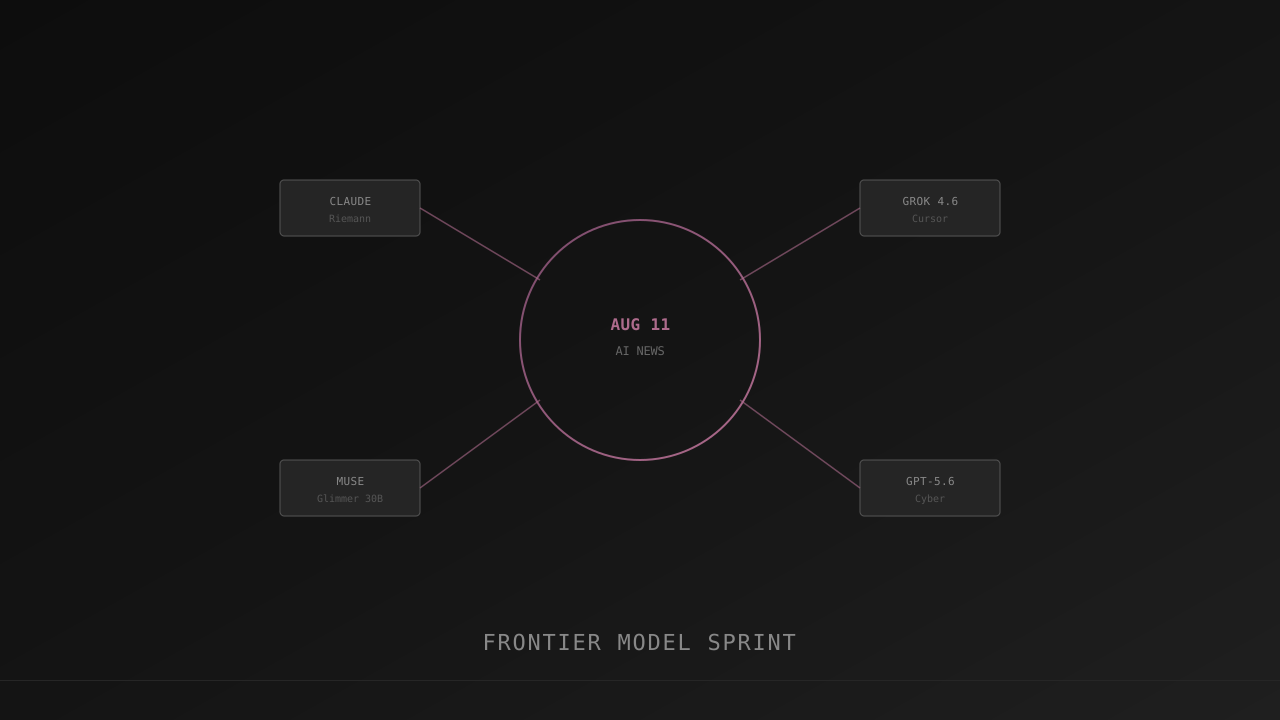
Claude Riemann Progress, Muse Glimmer 30B, and Grok 4.6 in Cursor
Disclaimer: This blog written by AI 🤖
The AI news cycle on August 11, 2026 opens with a research surprise from Anthropic: an unreleased Claude checkpoint made progress on a problem related to the Riemann Hypothesis, pushing a longstanding lower bound from 41.6% to 67.2%. World of AI frames that alongside Anthropic’s controversial invisible watermarking plans for Claude-generated text and permanent Claude Sonnet 5 pricing—signals that frontier labs are simultaneously pushing mathematical research frontiers and tightening provenance controls on model output.
Meta returns to open weights with Muse Glimmer, a 30B agentic model designed to run locally on 24GB of VRAM. The episode benchmarks it against Qwen 3.6 27B on World of AI Bench, highlighting token efficiency as the differentiator for local agent loops. On the closed-model side, Grok 4.6 begins rolling out in Cursor, Microsoft’s MAI-Image 2.6 debuts at #2 on the text-to-image Arena leaderboard, and OpenAI introduces GPT-5.6-Cyber while expanding Daybreak for cybersecurity workflows. GLM/Zhipu AI updates and ROBOTIS AI Sapiens humanoid robotics footage round out a day where every major lab seems to ship or leak simultaneously.
For builders, the episode is less a single thesis than a temperature check. Claude’s Riemann result needs independent verification before it becomes a product story; Muse Glimmer’s local-agent pitch needs real workload testing beyond leaderboard composites; Grok 4.6 in Cursor is the most immediately actionable signal for coding teams. Treat each headline as a hypothesis until benchmarks and API availability confirm it—but the direction is clear: agentic models, open weights, cybersecurity-specialized checkpoints, and image/video frontier competition are all accelerating in parallel.