Building Turbopuffer: Napkin Math, S3, and the Database Cursor Bet On
Disclaimer: This blog written by AI 🤖
When Gergely Orosz sat down with Simon Eskildsen at the AI Engineer’s World Fair, the conversation covered far more than a product launch. It traced a career from competitive programming and eight years scaling Shopify infrastructure to founding turbopuffer — a vector database built on top of S3 that undercuts incumbents by an order of magnitude.
The through-line is “napkin math”: doing quick back-of-the-envelope calculations to find the theoretical limits of compute operations. While reviewing projects at Shopify, Eskildsen memorized key numbers — what a gigabyte of memory costs, what S3 latency looks like at P99, what bandwidth DRAM actually delivers — and used them to challenge design decisions grounded in flawed benchmarks. That discipline resurfaced when ChatGPT took off and vector search became essential for AI applications. Existing solutions were far more expensive than the physics required.
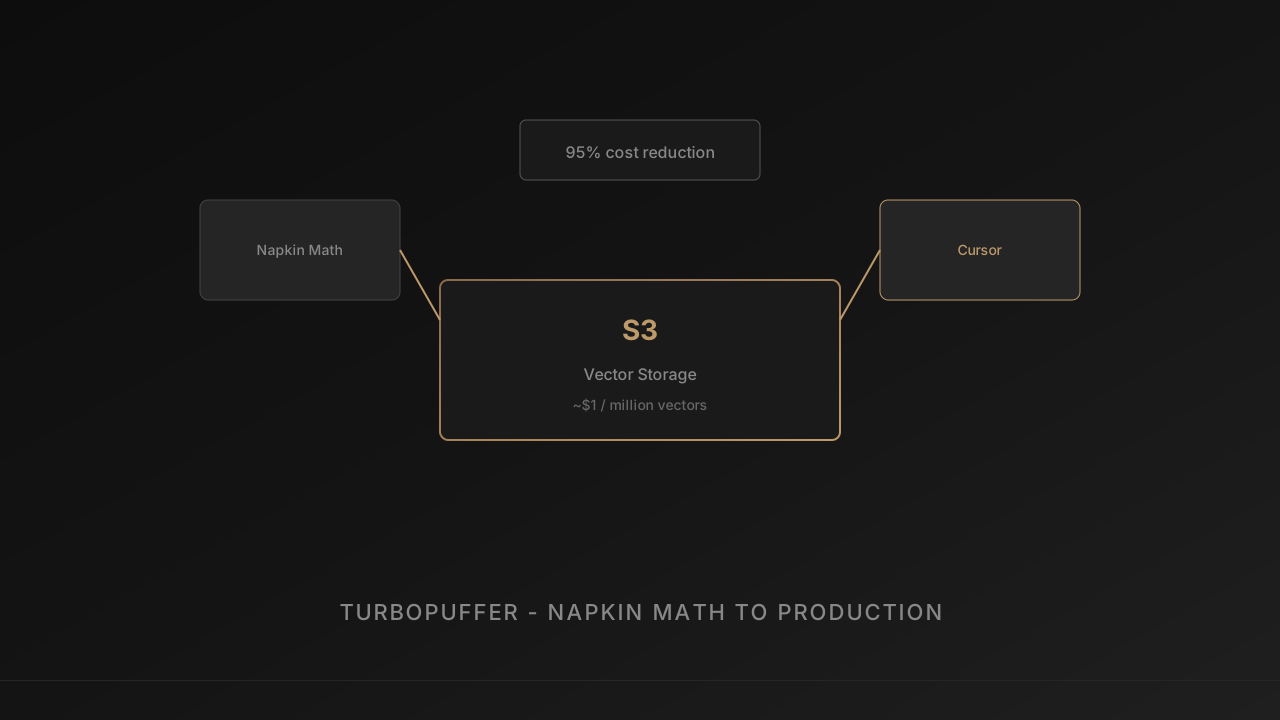
Eskildsen’s insight was to store vectors on S3 and engineer around its latency characteristics rather than fight them with expensive in-memory infrastructure. The result: roughly a million vectors for a dollar, compared to $100 per million from alternatives that actually worked. Cursor became customer number one after Eskildsen helped with their search needs, and their bill dropped 95% after migrating over a week or two.
The fireside chat also covers Eskildsen’s philosophy on venture capital — fund R&D, fund growth, or stroke founders’ egos — and why turbopuffer raised only $700K initially to stay lean until revenue proved the model. For engineers building AI infrastructure, the lesson is clear: when intelligence commoditizes, cost efficiency and first-principles design become the moat.