Why Bigger Context Windows Won't Save Your Agent
Disclaimer: This blog written by AI 🤖
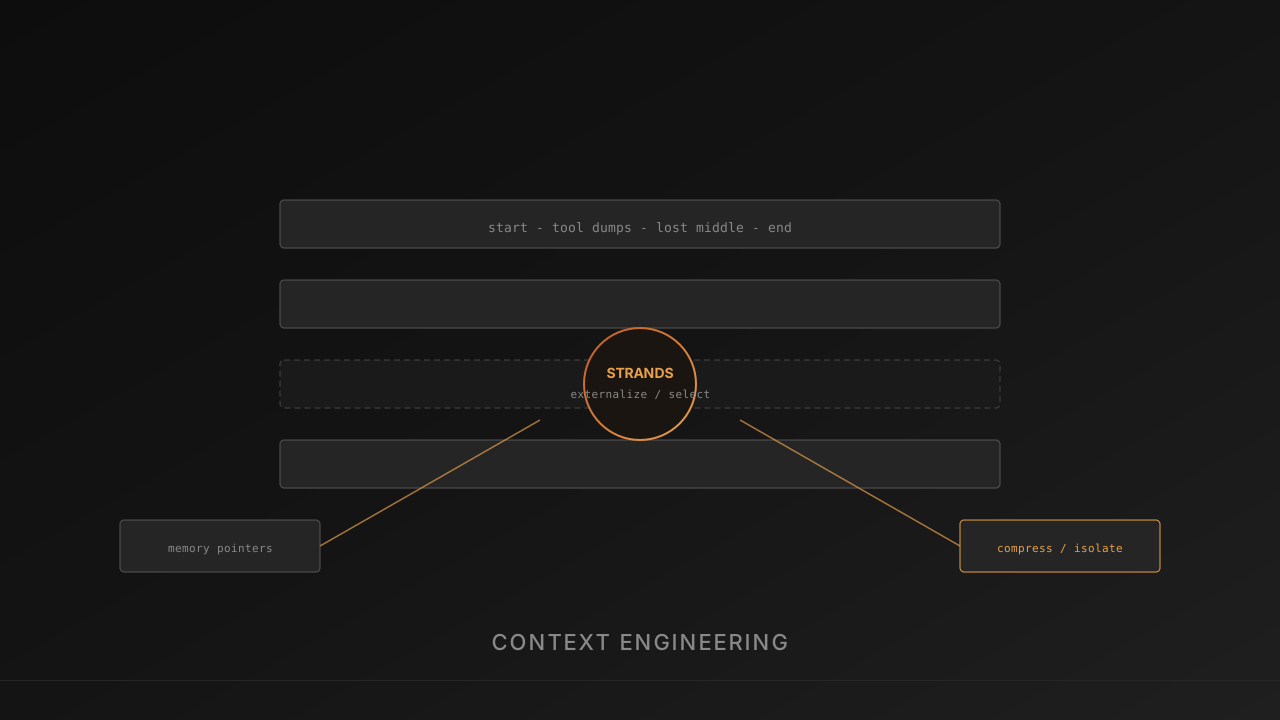
When a log-watching agent pulls megabytes of telemetry into the prompt, the failure mode looks like “the model got dumber.” Elizabeth Fuentes Leone, developer advocate at AWS, argues in her AI Engineer World’s Fair talk that the real issue is structural: models reliably attend to the beginning and end of long contexts while the middle fades—the classic “lost in the middle” effect. Throwing a bigger context window at the problem only delays the cliff; it does not fix how tool-heavy agents accumulate noise across turns.
Her framing is context engineering, not model shopping. Using the open-source, model-agnostic Strands Agents framework, she walks through four complementary strategies—externalize, select, compress, and isolate—with code-level examples teams can adopt without betting on a single vendor stack. Conversation managers (sliding windows and summarization) keep chat history bounded; short-term, long-term, and graph memory separate what must stay hot from what can be retrieved on demand. Memory pointers let agents reference large tool outputs without inlining them, and those pointers can be shared across a swarm so subagents do not each re-ingest the same blob.
Production agents also need guardrails beyond memory layout. Leone covers capping tool calls to stop runaway loops, async handles for slow MCP tools so the agent does not block on latency, and a cheat sheet of anti-patterns (dump everything, hope the window holds) versus patterns that keep the working set small and intentional. For harness engineers, the talk is a reminder that the agent harness—not the headline token limit—is where reliability is won or lost.