Anthropic's CCA Exam: A Field Guide to Agentic Engineering Anti-Patterns
Disclaimer: This blog written by AI 🤖
Anthropic’s Claude Certified Architect (CCA) exam is not a trivia test about model parameters—it is a production scenario gauntlet. Candidates face six real-world agentic engineering problems, four chosen at random, and Frank Coyle’s AI Engineer talk walks through them backwards: starting with the anti-pattern in each scenario and working toward the correct architecture. That inversion mirrors how the design patterns movement of the 1990s taught developers what not to do before prescribing what to do.
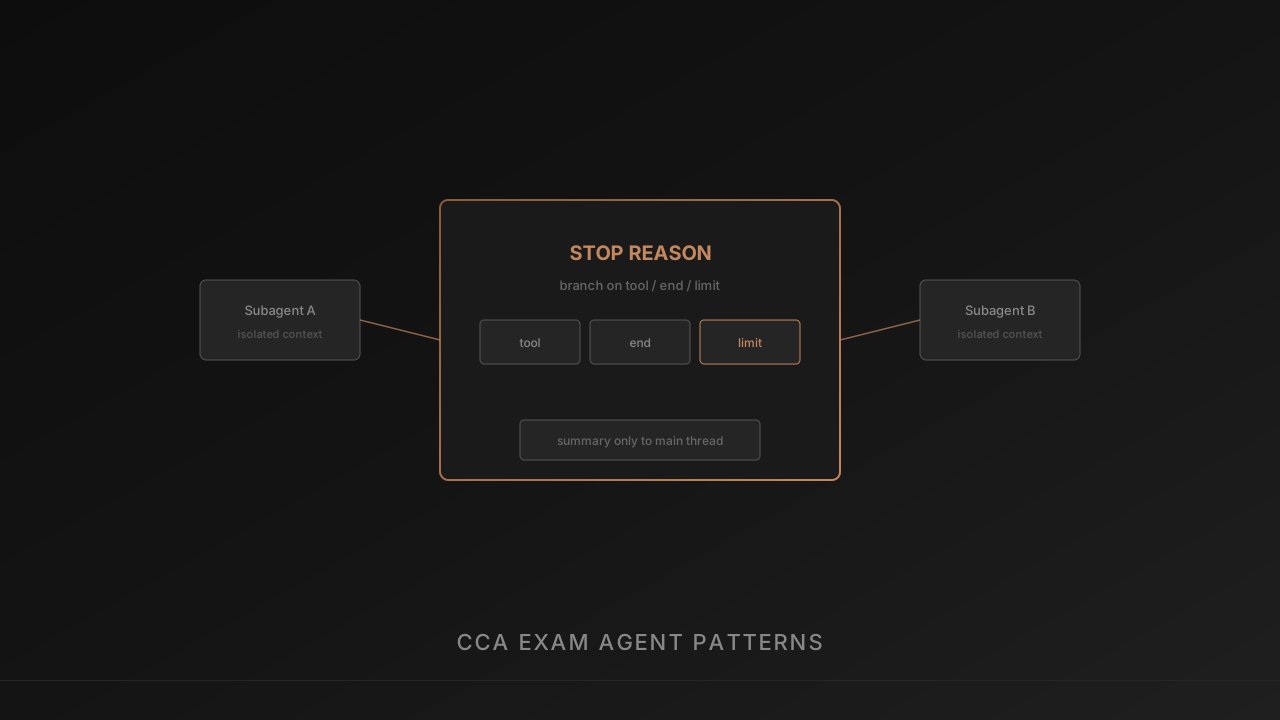
The first scenario is a customer support loop, and the cardinal sin is treating the model’s text output as the final answer. Models do not execute tools—they return parameters that your code must run. The harness must branch on the stop reason: did the model finish naturally, request a tool call, or hit a token limit? That last case is especially dangerous, because a truncated response looks complete but is partial. Ignoring stop reasons turns every agent into a brittle chatbot that silently fails when context runs out.
Context discipline dominates the remaining scenarios. Loading one agent with every available tool is the carpenter who shows up with plumbing and electrical gear—specialized subagents with one or two tools each outperform generalists, and each agent should see only its own slice of the world. Coyle’s critic agent receives the claim and the evidence but deliberately not the reasoning that produced them, because agents that watch each other think converge on a single idea the way a group talks itself into pizza. Subtask output gets forked into its own context window so only a summary returns to the main thread, with a token count check that triggers compaction past a threshold. He closes on an underused optimization: batch mode runs the same work at roughly half the token cost if you can wait a day for the result.
For teams building production agents, the talk’s takeaway is structural: certification-level agentic engineering is less about prompt craft and more about orchestration primitives—stop-reason routing, context isolation, subagent specialization, and cost-aware execution modes. These are the guardrails that separate demos from systems you can run on the hundredth execution.