Your Agents Lack Context: How Unblocked Cut Token Use in Half with a Context Engine
Disclaimer: This blog written by AI 🤖
AI-generated code should feel like it was written by someone who has been on your team for years — someone who sat through the meetings, got PRs rejected, and was on call the night production went down. Brandon Waselnuk, who works in developer relations at Unblocked, opens his AI Engineer talk with that standard and then shows how far most agents fall short. An agent starts every session with none of that institutional knowledge, and the gap compounds as teams move from tab completion toward parallel and background agents. The result is correction loops, wasted search tokens, and a review tax that scales with agent count rather than shrinking with model capability.
Waselnuk walks through two approaches that stall in practice. The first is the curated context trap: a team writes markdown files describing the project, then has to distribute them, watch them rot, and decide who has the taste to maintain them for everyone. The second is the MCP plateau — an agent may never call the server at all, or it hits satisfaction-of-search bias and stops at the first plausible answer while last night’s Slack thread saying to do the opposite goes unread. Access to information, he argues, is not understanding.
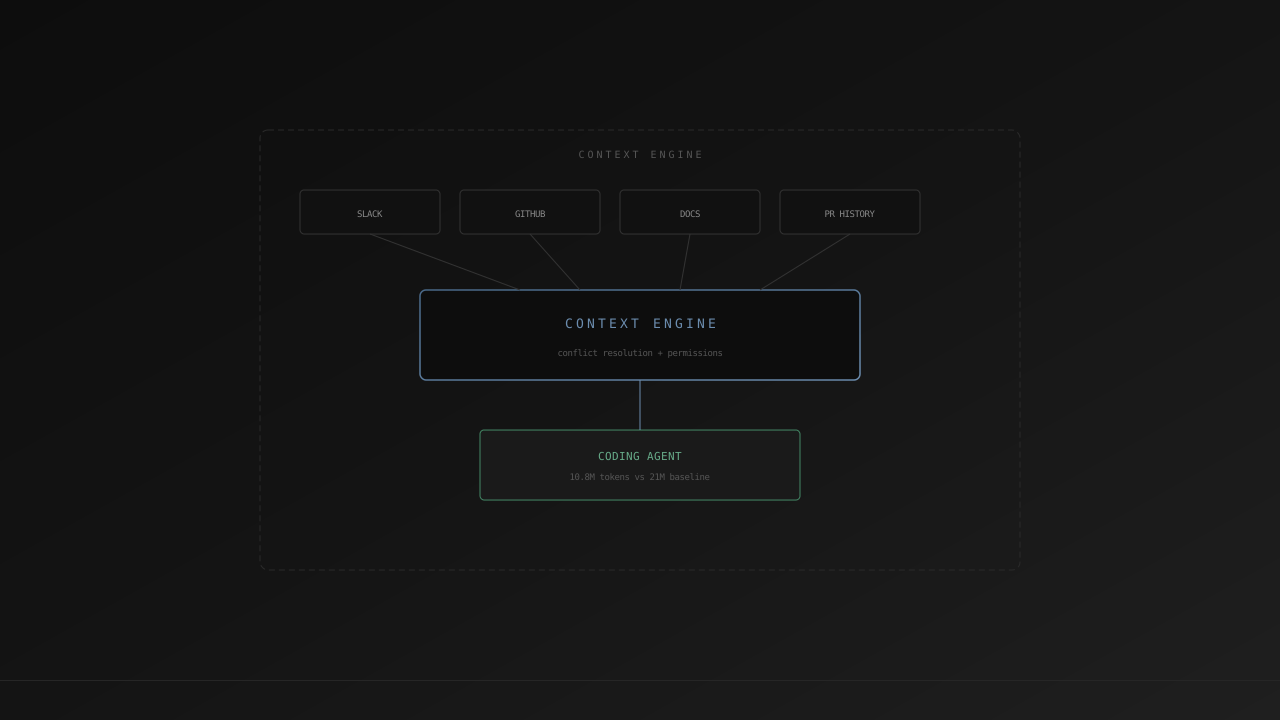
The core of the talk is what a real context engine owes you: conflict resolution when sources disagree, personalized relevance based on who is asking, permission enforcement so agents do not leak what they should not see, and the ability to synthesize across Slack, GitHub, docs, and PR history rather than dumping raw retrieval results into the prompt. Unblocked ran the same prompt against the same model twice — once with their context engine and once without. The run without it burned 21 million tokens; the run with it burned 10.8 million and finished about two hours sooner. Waselnuk closes by pointing to three open-source tools his team has released, including a workshop that builds a relational context engine from scratch.
For harness engineers, the lesson is that context is infrastructure, not documentation. MCP servers and markdown playbooks are necessary inputs, but without an engine that resolves conflicts, enforces permissions, and personalizes relevance, agents will keep burning tokens re-discovering what your team already knows.